Key Takeaways
- The Crespi Estate has now failed to sell at $60 million in 2023 and $47 million in 2024, and is asking $64 million today, seventeen million dollars higher than the price that already failed once.
- Dallas-Fort Worth's largest confirmed 2025 sale closed at $30.5 million, under half the current ask. The entire 2025 DFW market above $10 million was 15 sales worth $231.6 million combined, roughly 3.6 times one Crespi ask.
- DCAD values the main 11.9-acre parcel at $41.6 million with $925,821 in estimated 2026 taxes, about $2,536 a day, and it prices the dirt ($25.1 million) higher than the 1938 house that sits on it ($16.5 million).
- Every trophy home in this story that actually sold, sold at auction, 57 to 75 percent below peak ask. That includes the Crespi itself, which cleared at $36.2 million in December 2017.
- Near the estate, well-priced homes sell in 14 days at 98.8 percent of ask. The rest sit 56 days and settle at 91.6 percent. Across 50,702 DFW expired listings, relisting higher closes at a median 90 percent of the promised price.
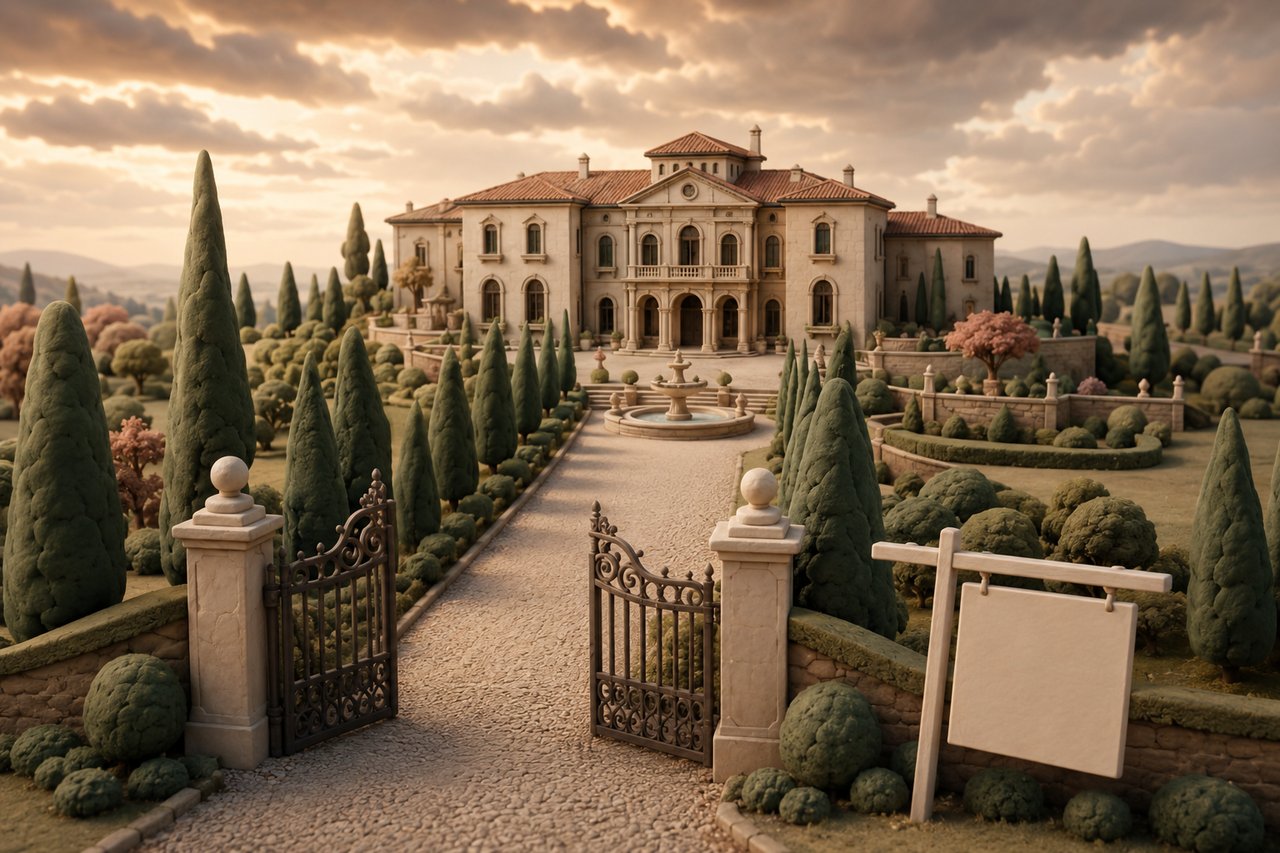
Texas's most expensive home for sale sits on 15.687 acres in Preston Hollow, and it has failed to sell at three different prices in three years. Listed at $60 million in 2023. Cut to $47 million in 2024. Relisted in February 2025 at $64 million, seventeen million dollars higher than the price that did not work the year before. As of this writing it is still active, roughly seventeen months into that third attempt, with no reported buyer.
That is the Crespi Estate at 5619 Walnut Hill Lane, and its stalled history is one of the most honest data points available on where the very top of the Dallas market actually sits. Not what a listing sheet claims. What buyers have actually shown up to pay.
A House With More History Than Buyers
Built in 1938 and 1939 for Italian Count Pio Crespi and his wife Florence, designed by Swiss architect Maurice Fatio, the estate has hosted the Duke and Duchess of Windsor, Coco Chanel, Jimmy Stewart, and Ronald Reagan. Tom and Cinda Hicks owned it from 1997 and listed it as high as $135 million before selling to banker Andy Beal in 2016 for an undisclosed price, reported anywhere from $58 million to $100 million and never officially confirmed. Beal put it to a no-reserve auction in December 2017; developer Mehrdad Moayedi won it for $36.2 million, reported as a U.S. record for a residential property sold at auction. In 2018 Moayedi carved roughly ten acres off the front to develop separately, then re-listed the house on less land. A trust tied to the Edwin L. Cox family, the Charlee Lochridge Cox Dynasty Trust, has owned it since 2019.
Today's listing: 27,092 square feet, 10 bedrooms, 12 full and 5 half baths, a 4,800 square foot entertainment pavilion with a 19-seat theater, a guest house, a greenhouse, and 15.687 acres assembled back together with three adjacent parcels. One of the most significant private residences in Texas. Unsold three times since 2023.
The Math That Explains the Stall
Dallas-Fort Worth's largest confirmed home sale of all of 2025 was 6601 Hunters Glen Road, which closed at $30.5 million, down from a $35 million ask. Number two, 4000 Euclid Avenue in Highland Park, closed at $25.5 million. The Crespi is asking $64 million, more than double the market's best 2025 result, at roughly $2,362 per square foot.
The county has its own opinion. Per the Dallas Central Appraisal District, the main parcel alone, 11.9 of the listing's 15.7 acres, carries a 2026 proposed market value of $41.6 million, with estimated annual property taxes of $925,821. That figure covers only the main account, not the three adjacent lots the listing bundles in, so it understates the full parcel. Even so, the $64 million ask still sits more than 50 percent above the county's number for the estate itself. Some gap between appraisal and ultra-luxury ask is normal. A gap this wide, on a market whose best confirmed sale last year was $30.5 million, is not.
There is a second detail buried in that appraisal. Of the county's $41.6 million, the land is worth $25.1 million and the house on it is worth $16.5 million. The county, in other words, values the dirt under the Crespi Estate higher than the 1938 mansion itself. Hold that thought.
What a Year of Owning It Actually Costs
Before anyone debates the sale price, look at the holding cost, because it explains why a seller at this level can wait out three failed prices without blinking.
Start with the number that is verified and exact. Property taxes on the main parcel run $925,821 a year per DCAD. Divide by 365 and that is about $2,536 a day, before you switch on a light, water the greenhouse, or pay a single person. Roughly $77,000 a month in taxes alone on an asset that is not moving.
Everything else on the stack is a sourced range, not a precise Crespi figure, and it is honest to treat it that way. No one has published what it costs to run this specific house, but the components are knowable:
- Insurance. High-value home insurance has become one of the most volatile line items in the category. Bloomberg reporters documented the owner of a $50 million mansion on Florida's Star Island being quoted $622,000 a year, up from $200,000 the prior year, roughly a threefold jump in one renewal cycle. That is a coastal, hurricane-and-flood illustration, not a Dallas number. Preston Hollow carries hail and wind risk but not windstorm exposure, so treat it as a national ceiling case for what climate-exposed trophy homes now pay, not an estimate for this house.
- Maintenance. The rule of thumb across luxury property, cited widely enough to be a convention rather than a study, is 1 to 4 percent of value per year on large estates. Applied to the county's $41.6 million, that is roughly $416,000 to $1.66 million a year. It is a framing device, not a quote.
- Staffing. Staffing-agency salary guides put an estate manager, a head housekeeper, and a groundskeeper each into six figures a year, before a 20 to 30 percent load for payroll taxes and benefits, and before you staff to the actual scale of 15.7 acres, a greenhouse, two tennis courts, and an entertainment pavilion.
Only the $925,821 tax bill is exact, but even a conservative reading of the rest points to an all-in carrying cost that plausibly runs into the millions a year, before any debt service. The point is not the precise total. It is that the current owner can absorb it indefinitely, which is exactly why the ask went up after two failures instead of down. When you do not need to sell, the market's opinion is optional.

Trophy Homes Clear at Auction, Not at Ask
Here is the pattern the Crespi listing is fighting, and it is well documented. Concierge Auctions, the firm that ran the Crespi sale in 2017, publishes its own Luxury Homes Index on exactly this question. Across its book of business, listed trophy properties sell for an average of 13 percent below their initial list price. But that average hides the real story, which is time. Properties that sell within 180 days average 94 percent of list. Properties that take longer average somewhere between 77 and 81 percent, depending on the report year. The average trophy property in the index takes 319 days to sell, more than five times a normal residential sale. The longer a trophy home sits, the worse its eventual number, and these are the auction house's own figures.
CNBC, reporting on the mega-mansion auction market, found that the three highest-priced homes ever sold at auction had their asking prices slashed by an average of 70 percent, with one landing $116.5 million short of its first ask. The same reporting put luxury auction sales at 74 percent of list price in 2022, 91 percent in 2023, and 86 percent in 2024 as sellers learned to price closer to reality before invoking the auction.
Now overlay the Crespi's own history. It listed at $135 million in 2013, re-listed at $100 million in 2015, cut to $48.9 million by early 2017, and finally cleared at $36.2 million at a no-reserve auction in December 2017. That is a 26 percent discount from the immediate pre-auction ask and roughly 73 percent off the original peak. The house did not defy the pattern. It is the pattern. Its only real trade in a decade came at auction, deeply below ask, precisely as the index predicts.
This Movie Has Played Before, at Every Price Tier
The Crespi is not an outlier, and it is not even the most extreme version of this story. The very top of the market discounts like this everywhere, and it does it in public.
"The One" in Bel Air was pitched at a $500 million target in 2015. By the time its developer went bankrupt, Concierge Auctions listed it at $295 million, and in March 2022 it sold at a no-reserve auction for a $126 million hammer price, $141 million with the buyer's premium, to Fashion Nova CEO Richard Saghian. That is roughly 75 percent off the original number, and it set the U.S. record for the largest property sale at auction.
Chartwell, the Bel Air estate known from "The Beverly Hillbillies," listed off-market at $350 million around 2017, cut to $245 million, then $195 million, and finally sold to News Corp co-chairman Lachlan Murdoch in December 2019 for a figure reported as closer to $150 million, about 57 percent below the original ask. At the time it was the highest home sale in California history.
Property | Location | Peak ask | Sale result | Discount |
|---|---|---|---|---|
The One | Bel Air, CA | $500 million (2015) | $126 million hammer, $141 million with premium (Mar 2022) | ~75% |
Chartwell | Bel Air, CA | $350 million (2017) | ~$150 million (Dec 2019) | ~57% |
Crespi Estate | Preston Hollow, TX | $135 million / $100 million | $36.2 million at auction (Dec 2017) | ~73% |
Three houses, three cities, three decades of buyers, one behavior: the trophy tier does not clear at ask. In these three cases it cleared 57 to 75 percent below peak ask, at auction, after a long wait. The $64 million on the Crespi listing is not a price a buyer is expected to pay. It is the number you paint on a house you do not need to sell.
Worth More As Dirt?
Remember that the county values the land at $25.1 million and the house at $16.5 million. That inversion points at the question any institutional buyer actually runs on a property like this: is the highest and best use one $64 million trophy, or several Preston Hollow homesites?
There is precedent, on this exact parcel. When Moayedi bought the estate at auction in 2017 he did not keep it whole. In 2018 he carved roughly ten acres off the front to develop separately and re-listed the house on the remainder. DCAD prices the land here at $3,000,000 an acre, then applies a 30 percent market adjustment, which is how it reaches the $25.1 million land value on 11.9 acres. On a parcel this size, in a neighborhood where estate lots are scarce, the arithmetic of subdivision competes directly with a single trophy sale, and the current listing tellingly bundles three adjacent lots back in, keeping that optionality alive.
None of that guarantees a teardown. This is a landmark house, and a preservation-minded buyer may pay for the whole. But it explains why the land, not the mansion, is where the county puts the value.
Who Actually Buys At This Tier
The buyer pool for a $64 million public listing is genuinely thin, and for once there is a clean way to size it. Per Compass's 2025 Ultra-Luxury Report, Dallas-Fort Worth recorded 15 home sales above $10 million in all of 2025, up from 13 the year before, totaling $231.6 million in volume, a 30 percent dollar-volume jump that led every metro in Texas. That is the entire top of the market for a year: 15 transactions worth in total about 3.6 times what this one house is asking. A single $64 million sale would be nearly a third of the whole $10 million-plus market by itself.
Be disciplined about what the data does and does not say. There is no published, credible days-on-market or cash-share figure for the Dallas $10 million-plus tier, so we are not going to invent one. But there is a pattern in the deals that did close. Both confirmed Dallas trophy purchases on record here, the Cox family trust that bought the Crespi in 2019 and the unnamed trust that bought 4000 Euclid Avenue in December 2025, were structured through trusts, not named individuals on the deed. At this level buyers show up quietly, through entities, on their own timeline. That is a hard pool to reach with a public MLS listing, which is part of why so much of this tier trades off-market.
What This Means For Your $2M to $5M Sale
None of this signals a soft Dallas luxury market. It signals that the $30 million-plus one-of-one tier trades in a different world than the $2 million to $5 million homes that make up the real working luxury market in Preston Hollow, Highland Park, and University Park. Our own MLS warehouse puts numbers on that market. Within 1.5 miles of the Crespi Estate, the second quarter of 2026 closed at a median of $2.74 million, per our July 18 warehouse pull, with a median of 35 days on market [MLS: dom_curve.median_dom=35 @ radius:32.8838,-96.8155,1.5].
And here is the stat that explains the whole Crespi saga in miniature. A third of those homes, the ones priced right from day one, sold within 14 days [MLS: dom_curve.fast_share_pct=33.0% @ radius:32.8838,-96.8155,1.5] at 98.8 percent of original ask [MLS: dom_curve.fast_median_pct_of_original=98.8% @ radius:32.8838,-96.8155,1.5]. The rest sat a median of 56 days [MLS: dom_curve.slow_median_dom=56 @ radius:32.8838,-96.8155,1.5] and settled at 91.6 percent of ask [MLS: dom_curve.slow_median_pct_of_original=91.6% @ radius:32.8838,-96.8155,1.5]. Put it in a table and the decay is impossible to argue with:
Listing behavior | Share of nearby sales | Median days on market | Median percent of original ask realized |
|---|---|---|---|
Priced right from day one | 33% | 14 or fewer | 98.8% |
Everything else | 67% | 56 | 91.6% |
Finish the arithmetic the metaphor is pointing at. The gap between 98.8 and 91.6 is 7.2 points of your asking price. On a $3 million Preston Hollow listing, 7.2 points is about $216,000, decided almost entirely in the first fourteen days. That is not a rounding error. It is the price the market charges for the same hesitation the Crespi is displaying at twenty times the scale.
The mechanics of a $64 million estate and a $3 million home are not the same. One stalls because its buyer pool is tiny and off-market; the other sells fast because its market is liquid. What travels between them is not the mechanism. It is the behavior. The market talks back, in showings that do not convert and feedback that repeats, and the seller's job is to listen faster than the Crespi has.
The Relist-Higher Penalty, In Our Own Numbers
The single most expensive move in the Crespi story is not the original price. It is the decision to relist higher after failing, from $47 million in 2024 to $64 million in 2025, up seventeen million dollars after the market had already said no twice. We can tell you what that strategy does, because we measured it.
In a Paragon MLS warehouse analysis of 50,702 DFW expired listings from 2024 and 2025, listings that came back at a higher price with a new agent do eventually close about 65 percent of the time, but at a median of just 90 percent of that promised higher ask, and 24 percent of them fail a second time. Sellers who instead repositioned lower closed at 95 percent of their new ask. And the pattern is already repeating: of 2026's price-up relists, 49 percent have already walked the price back down.
One honest caveat, because the number invites over-reading. There is a selection effect. Sellers who relist higher ultimately bank about 97 percent of their old failed ask, versus 89 percent for those who reposition lower, which sounds like raising the price wins. It does not. Sellers who can afford to hold out for the old number are a different group than sellers who have to move, and the higher recovery reflects who they are, not what the strategy does. This is correlation, not a lever you can pull. What is not ambiguous is the cost in time and certainty: relisting higher buys a longer road and a one-in-four chance of failing again. The Crespi is on that road right now.
The Honest Counterargument
A one-of-one estate is not a comp for anything, including itself five years ago, which is exactly why this listing has taken three swings to find its number, if it ever does. One right buyer, wanting this exact landmark house on this exact land, ends the story tomorrow regardless of what the math says. Trophies are bought with conviction, not spreadsheets.
The current owner also may simply not need to sell. A tax bill north of $925,000 a year, on an asset held in a dynasty trust by a family at this level of wealth, is closer to a rounding error than a pressure point. "Nobody wants it" is the wrong frame. The truer version is that the owner does not need anyone to want it, which is a luxury almost no ordinary seller shares.
The Paragon Angle
The Crespi Estate's real lesson is not about mansions. It is that listing history is public, permanent, and read by every buyer's agent like a credit report. Three prices in three years does not read as flexibility. It reads as a seller who has not accepted what the market already said twice, and buyers discount for that hesitation.
That is why our pricing conversations run backward from most. We do not ask what a seller wants to test. We ask what number clears in two weeks, because our expired-listing data says the test itself is what gets expensive: relist higher and the median outcome is 90 percent of the promised price and a one-in-four chance of a second failure. Every week past the neighborhood norm hands the buyer's agent a talking point you paid to create. The Crespi Estate can afford a $925,000 tax bill while it waits out a one-of-one buyer. A normal seller cannot afford the quieter version of the same mistake. Price to the first two weeks, listen to the first feedback cycle, and never relist higher out of frustration. The market has a long memory and no sympathy.
Frequently Asked Questions
Has the Crespi Estate in Dallas sold yet?
No. It remains active at $64 million, the price it has carried since February 2025, and has not sold at any of its three asking prices since 2023.
Why hasn't the Crespi Estate sold?
Dallas-Fort Worth's largest confirmed 2025 sale closed at $30.5 million, less than half the Crespi ask, and the entire 2025 DFW market above $10 million was only 15 sales worth $231.6 million combined. Trophy homes this size draw from a tiny, largely off-market buyer pool, and the comparable estates in this piece historically sold 57 to 75 percent below peak ask.
How much are the property taxes on the Crespi Estate?
Per the Dallas Central Appraisal District, the main 11.9-acre parcel carries a 2026 proposed market value of $41.6 million with estimated annual taxes of $925,821, about $2,536 a day, before insurance, staffing, and grounds upkeep on nearly 16 acres.
Does a stalled ultra-luxury listing mean the Dallas luxury market is weak?
Not the working luxury market. Within 1.5 miles of the estate, homes closed at a median of $2.74 million in the second quarter of 2026, and the well-priced third of them sold within two weeks at 98.8 percent of ask. The stall lives in the thin one-of-one tier.
What can a regular home seller learn from a $64 million listing that won't sell?
That the market sets the price, and that relisting higher after a failure is measurably costly. Across 50,702 DFW expired listings, coming back at a higher price closed at a median of 90 percent of the promised ask, with 24 percent failing a second time. Repeated cuts or a lack of showings are the market telling you the number.
Conclusion
The Crespi Estate will resolve one of two ways. A single buyer who wants this exact landmark on this exact land appears and none of the math matters, or the listing hardens into the definitive Dallas case study in what a price that ignores its own market twice actually costs. Either ending writes the same footnote. What happens next is worth watching precisely because it is legible: a fourth price, a quiet move to auction, or a subdivision play on land the county already values above the house. Any of those three would say more about where the top of the Dallas market really sits than another year of listing-sheet asks. And for every seller who will never touch a count's estate, this one remains the clearest teacher in the market right now, because the discipline it breaks in public is the same discipline that quietly decides an ordinary sale.
Talk to Paragon
Ready for a pricing strategy built on what actually clears? Let's connect and discuss your goals: call (469) 290-7593 or visit paragondfw.com/contact.
Whether you are pricing a starter home or a one-of-one estate, the analysis is the same: what has the market proven it will pay, not what a listing sheet claims. We would be glad to walk through it with you.
Reach us at [email protected] or call (469) 290-7593. More at paragondfw.com.
Sources
- CandysDirt - If You Have a Spare $64 Million the Crespi Estate Can (Again) Be Yours! - https://candysdirt.com/2025/02/27/if-you-have-a-spare-64-million-the-crespi-estate-can-again-be-yours/
- The Real Deal - Dallas' Crespi Estate Listed for $64 Million With Adjacent Lots - https://therealdeal.com/texas/dallas/2025/02/26/dallas-crespi-estate-listed-for-64-million-with-adjacent-lots/
- People Newspapers - Crespi Estate Returns to Market With More Land, Higher Price - https://www.peoplenewspapers.com/2025/04/23/crespi-estate-returns-to-market-with-more-land-higher-price/
- CandysDirt - Andy Beal Closed on the Hicks Residence, Now the Most Expensive Real Estate Transaction in Texas History - https://candysdirt.com/2016/01/15/andy-beal-closed-hicks-residence-morning-expensive-real-estate-transaction-texas-real-estate-history-now-done/
- CandysDirt - Mehrdad Moayedi Buys Crespi Estate Walnut Place at Auction for $36.2 Million - https://candysdirt.com/2017/12/20/mehrdad-moayedi-buys-crespi-estate-walnut-place-auction-36-2-million-inside-pics/
- Forbes - Most Expensive Home Ever Sold in Dallas Could Now Be Most Expensive Flip in Texas (Moayedi subdivision) - https://www.forbes.com/sites/candaceevans/2018/08/08/most-expensive-home-ever-sold-in-dallas-could-now-be-most-expensive-flip-in-texas/
- The Real Deal - Dallas-Fort Worth's Top Home Sales of 2025 - https://therealdeal.com/texas/dallas/2025/12/24/dallas-fort-worths-top-home-sales-of-2025/
- The Real Deal - This Discounted Spec Mansion Leads Texas' Slow Season Sales - https://therealdeal.com/texas/dallas/2026/02/17/this-discounted-spec-mansion-leads-texas-slow-season-sales/
- Dallas Central Appraisal District - Residential Account 005516000001F0000 (5619 Walnut Hill Ln, 2026 proposed values), pulled 2026-07-19 - https://www.dallascad.org/
- Concierge Auctions - Luxury Homes Index - https://www.conciergeauctions.com/luxury-homes-index
- Concierge Auctions - Selling Luxury Property at Auction (methodology) - https://www.conciergeauctions.com/methodology
- Common Dreams (summarizing Bloomberg reporting by Felipe Marques and Devon Pendleton) - Mega-Rich Are Paying $600,000+ a Year to Insure Their Mansions - https://www.commondreams.org/news/home-insurance-climate
- Home Team Hires - Estate Manager Salary Guide 2026 - https://www.hometeamhires.com/estate-manager-salary-guide
- Compass - 2025 Ultra-Luxury Report (15 DFW sales above $10M, $231.6M total) - https://www.compass.com/newsroom/press-releases/1E0XYg5a4vLG32GwnxrcFz/
- Wikipedia - The One (Los Angeles) - https://en.wikipedia.org/wiki/The_One_%28Los_Angeles%29
- Forbes - Beverly Hillbillies Estate (Chartwell) Sells For $200 Million Less Than Its Initial Asking Price - https://www.forbes.com/sites/amydobson/2019/12/12/previously-asking-350m-chartwell-estate-breaks-california-records-and-comes-in-second-for-us-as-a-whole/
- Local market figures: Paragon MLS warehouse (NTREIS), pulled 2026-07-18; Paragon MLS warehouse analysis of 50,702 DFW expired listings, 2024-2025.